Recent Articles

  • Laura Gascoigne: The Masterpiece Delusion

    Laura Gascoigne

    Thank God for books. When shut off from real life, you can see it reflected in novels. But how accurate is the reflection? Does the mirror distort? In month ten of the no-longer-new-abnormal I sat down with a stack of novels about artists. Some I’d read before, others were new, chief among them the fons et origo of the genre, Émile Zola’s L’Oeuvre, first serialised in French in 1885.
    At 500 pages Zola’s book is certainly an oeuvre, though not a masterpiece. The 14th novel in his Rougon-Macquart series, it’s the one most closely based on personal experience. His friendship with Paul Cézanne, going back to their schooldays in Aix-en-Provence, gave him an early entrée to the Paris avant-garde; at 26 he came out fighting on behalf of Manet and co in a series of critiques of the Salon of 1866. L’Oeuvre, written 20 years later, represents “the Parisian art world as it really was,” claims Edward Vizetelly, its first translator into English as His Masterpiece. The novel is a roman à clef with composite characters that don’t necessarily fit particular locks. Its doomed painter hero Claude Lantier is a mash-up of Cézanne and Manet, while his best friend the novelist Pierre Sandoz is quite clearly Zola and gets all the best lines, eg: “How can a man be sufficiently wanting in self-doubt as to believe in himself?”

    The book is said to have ended their friendship but in fact, apart from the “bluey tinge” of his palette and his lack of social graces, Lantier hardly resembles Cézanne at all. For a start, Zola makes his hero the illegitimate son of a laundress living on a small allowance from a benefactor who recognised his talent. Cézanne’s background was too bourgeois for Zola’s purposes: the son of a provincial banker, his friend lived on a family allowance he was so desperate to keep that he hid the existence of his mistress and son from his father, only marrying in 1886, the year of the old man’s death. No wonder Hortense looks so sour-faced in pictures. The line in the novel Cézanne was least likely to forgive is put into the mouth not of the painter Lantier but the art critic Jory: “And so we waited for my father’s death, and then I married her.”

    But I suspect what Cézanne couldn’t stomach was the melodrama. “A fever stiffened him, he worked on with the blind obstinacy of an artist who dives into his entrails to drag therefrom the fruit that tortures him.” Pur-lease! The mix of metaphors alone would be a turn-off for any painter of apples. And Lantier’s obsession with creating a single masterpiece is ridiculous. What Zola gets right, though, is the dedicated artist’s essential selfishness; as Lantier confesses to the equally doomed heroine Christine on day one: “As for me, when it’s a question of painting, I’d kill father and mother you know”. She couldn’t say she wasn’t warned.

    Solipsistic selfishness is a constant in the characters of artists in novels. “He is an exceptional man,” Vermeer’s friend van Leeuwenhoek warns the heroine of Tracy Chevalier’s Girl with a Pearl Earring. “His eyes are worth a room full of gold. But sometimes he sees the world only as he wants it to be, not as it is. He does not understand the consequences to others of his point of view. He thinks only of his work, not of you.” 

    Clutton, the leader of a gang of young English artists on the loose in Paris in Somerset Maugham’s Of Human Bondage, is a chip off the Lantier monomaniac block: “The only reason that one paints is that one can’t help it… One paints for oneself, otherwise one would commit suicide.” Lantier takes that final option, but Maugham’s hero Philip foresees a less dramatic end for Clutton: he saw him “in twenty years, bitter, lonely, savage and unknown; still in Paris … at war with himself and the world, producing little in his increasing passion for a perfection he could not reach: and perhaps sinking at last into drunkenness.” Clutton’s own hero is a chap he met in Brittany who’s just off to Tahiti – a former stockbroker with a wife and family. “‘He chucked it all to become a painter.’ ‘And what about his wife and family?’ asked Philip. ‘Oh, he dropped them. He left them to starve on their own account.’ ‘It sounds a pretty low-down thing to do.’ ‘Oh, my dear fellow, if you want to be a gentleman you must give up being an artist… An artist would let his mother go to the workhouse.’”

    No prizes for guessing the identity of this ungentlemanly chap. Gauguin had a fascination for Maugham, who returned to him four years later in The Moon and Sixpence, the story of a London stockbroker who abandons his wife and children to go to Paris and become an artist, ending up in Tahiti. Like Lantier’s, his paintings have a strange power. “They seemed to me ugly, but they suggested without disclosing a secret of momentous significance,” is the narrator’s verdict when he first sees them in Paris. Years later in Tahiti he learns from the local doctor of a climactic cycle of paintings burnt on the artist’s orders after his death. “I think Strickland knew it was a masterpiece… He had made a world and saw that it was good. Then, in pride and contempt, he destroyed it.”

    What would the real Gauguin would have made of this romantic flim-flam? I suspect he’d have liked it even less than Cézanne liked Zola’s L’Oeuvre. Gauguin had plenty of pride and contempt, but it was not directed at posterity. He was in fact a rare example of an artist sufficiently wanting in self-doubt to believe in himself. For a reality-check on how artists actually think, novelists could do worse than to read his final memoir, Before and After, written on The Marquesas in 1903. Gauguin was no self-destructive Strickland: “I have worked and spent my life well, intelligently, even courageously, without weeping, without tearing things,” he concludes “– and I have very good teeth.” Nor did he treat his family heartlessly, if you believe Émile’s defence of his father in the preface to the first edition. “It is a good story,” Émile dismisses the Gauguin myth. “It is a pity to contradict it, so many credulous souls have been entertained by it. But alas, it is not true.”

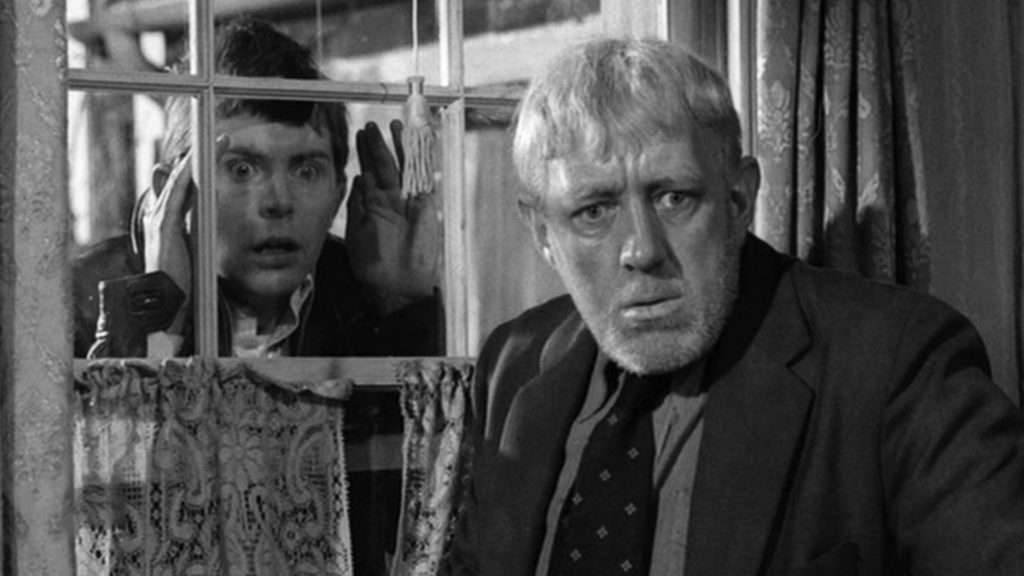
    Many credulous souls are entertained by novels about artists but alas, they’re not true either. The one exception is The Horse’s Mouth, whose author Joyce Cary, like Maugham’s Philip, studied art in Paris but gave it up when he realised he was third-rate. Cary’s anti-hero Gulley Jimson (illustrated, played by Alec Guinness in Ronald Neame’s 1958 film) has the artist’s essential selfishness and ambition to paint masterpieces, but it’s the practicalities – the getting of materials and walls to paint on – that exercise him. There’s no diving into entrails for torturous fruits. Jimson is a desperado, not a fruitcake.

    Of all the novels about art and artists, Cary’s is the only masterpiece. But let’s give the last word to the non-fictional Gauguin: “As you see, everything is serious and ridiculous also. Some weep, others laugh… What is one to do about it? Nothing. All this must be; and, after all, it’s of no consequence. The earth still turns round; everyone defecates; only Zola bothers about it.”

  • 2020 Blindness

    David Lee

    March/April 2021

    Nothing much happened last year in the visual arts. The usual suspects promoted themselves with yards of trivia, usually about the NHS, but nothing serious was made except by those conventional sorts who go quietly about their business. National galleries tried to fill the gap by selling us ‘virtual’ and ‘digital’ ‘experiences’ by the dozen, but no one who relishes looking at art will be satisfied by that. Viewing a ‘virtual’ painting is about as satisfying as eating a ‘virtual’ Mars bar. Imagine, though, how much cheaper it would be if ‘virtual’ was enough. We could treat the National Gallery like Debenhams or Topshop ­– put the collection online, asset strip it and flog the real estate to a Russian crook. Art made easy, and no overheads. 

    Apart from a couple of agreeable jaunts, each of them to a deliciously empty National Gallery, V&A and a half-closed British Museum (no change there, the Bassae frieze and the galleries displaying architectural fragments were as ever roped off), I can’t say I missed anything – a shocking admission but true. Certainly, I haven’t agonised over the closing of Arts Council galleries, the Serpentine, ICA, Hayward, Whitechapel, or the other predictable troughers jostling at Rishi’s steaming gravy boat (borrowed).

    2020 ought really to stand as one of those benchmark years, after which everything altered. The series of lockdowns provided perfect conditions for thoughtful realignment. And as far as debt, bankruptcies, blameless victims and especially unemployment are concerned, 2020 will indeed become a year like those historical benchmarks surrounding which there is a definite sense of before and after; 43, 1066, 1689, 1789, 1815, 1832, 1929, 1948, 1969 and, more recently, 9/11 and fiddling with the offside rule.

    If anything in 2020 needed a thick black line drawing under it it was State Art, so conspicuously has it abandoned any pretence to be taken seriously. Conceptual art, its preferred approach, has been belly up for years. Only the mutual interests of selected curators, artists, dealers and collectors, plus a few reliably supportive hacks (and not forgetting the millions in public subsidy) have seen to it that it survived well beyond its sell-by date irrespective of growing public mockery and indifference. Recent Turner Prizes and Fourth Plinths, which continued their annual mummified parades like El Cid, came and went and nobody cared who won … Well go on then, name one! We could tell that State Art didn’t really believe in all of this themselves because the explanations of ‘experts’ had to be written in a foreign language only they understood. And when all else failed there was special pleading, threats of an imminent return to savagery and the resort to quasi-religious bullying – the vehement insistence that there is something ‘innovative’ and ‘challenging’ there when there isn’t. We’d get the hang of it eventually, they kept telling us from a great height. Except we didn’t.

    It would be reassuring to believe that the void of 2020 supplied the potential crucible for a new structure in the visual arts, but it doesn’t look likely. Not even a worldwide slaughter of innocents can deflect the rightness of those in charge here. During the last decade, in parallel with their devotion to an embalmed conceptualism, has evolved their own special Creed. Every day their happy-clappy Wokeism selects the dubious and undeserving (some of them barely literate; see Moping Owl), while their shameless political grandstanding exhibits a disregard for anything recognisable as Art.

     No one in 2020 missed State Art. Its High Priests tell us we are being starved of culture, but in truth they only miss themselves. Robbed of their addiction to publicity, only lying makes them feel better, and as ever wishful thinking is presented as fact. To be honest I couldn’t care less if I never visit the Hayward again. I won’t feel deprived or hunger at the loss. There is always the nationals, cherished buildings, bookshelves, film and Sky Sports.

    Will the hiatus of 2020 stop these monomaniacs giving us more of the same? No. Why? Because Wokeist State Art resides in an impregnable soundproofed fortress without windows. They neither see nor hear us. We exist only to pay their wages. Ignoring the opportunities for change presented on a plate during 2020, State Art is, like the Chinese Communist Party, a self-perpetuating elite which only distributes patronage to reliable fellow believers while punishing everyone else for thinking differently.

    For most people throughout our whole sad world 2020 was an unforgettable watershed, but not for State Art. David Lee

  • Dick French: Art of Jazz, London’s Art Scene

    Dick French

    A curious little book has just come out called The Death of Francis Bacon. The author, Max Porter, won the International Dylan Thomas Prize some time ago. Whenever awards are deployed I always think of Charlotte Rampling who, in her film The Swimming Pool, remarked: “Awards are like haemorrhoids, sooner or later every arsehole gets one.”

    It’s not a very good book. Maybe it was written as a short radio play. However, the author is sound on Bacon’s 20-year decline, which was not so much a decline as a falling off a cliff, about 1970. After that he floundered desperately, grasping at old motifs and habitual tricks, the arrows, the Letraset, the spunk shots … not forgetting the cricket pads. Who could ever?

    Fat Vlad in the Sunday Times writes about the 2017 Soutine show at the Courtauld … “The first and only Soutine exhibition in living memory.” Well, I don’t know how old he is but I vividly remember a splendid Soutine show at the Hayward in the early ’80s. It was enormous and completed banished the effect of all that concrete. Vlad makes much of Soutine’s squalor, the bedbugs in the ear, etc.. But Soutine became successful and quite rich, an elegant hombre about town, if always rather nervous and twitchy. He is supposed to have painted just one nude, part of which is illustrated in his little article. It’s so good I can’t believe that it’s his first. There must be more. Don’t believe everything you read in art books.

    The Carcass of Beef is said to have been a big influence on abstract expressionism. This is nonsense. In spite of the violence of his approach and the seemingly random application of paint, as you look at it you realise that every brushstroke describes form. Look at the dangling stomach sac in the centre, which at first you don’t notice, shiny and translucent, quite sick-making.

    A rather nice book called The Art of Jazz has just come my way. It’s be Alyn Shipton (perhaps he’s Welsh) the chap who says “he…llo” at the start of Jazz Record Requests on the wireless. There are quite a few record covers by Andy Warhol before he became famous. He did them with the aid of an epidiascope before colouring them in.

    Photographs, record covers, paintings and drawings from the old Ragtime syncopaters to the present day… Clearly written it’s a pleasure to read, and such a change from art books. Quite a bit on Cab Calloway, always one of my favourites. A photo of him performing in a white zoot suit is outstanding. He was a major figure in the swing era, although Dizzy Gillespie hated him and once stabbed him in the bum on the bandstand. But it was only a playful jab, half an inch or so. Dizzy needed to improvise but Cab made everyone stick to the score.

    It’s interesting to read about the Los Angeles Zoot Suit Riots of the 1940s. Off-duty servicemen would prowl around looking for ‘hep cats’ to beat up. It was a period of relative austerity in the USA and materials were supposed to be used sparingly. The zoot suit guys liked to flaunt their cloth.

    There is no mention of Louis Jordan in this book which I find odd. He was a major bandleader of the time who also like to flaunt his cloth. Open the Door Richard is one of the earliest tunes I remember. People used to sing it at me all the time. Stanley Kubrick took some photos of the George Lewis band in New Orleans. They were known as the ‘keepers of the flame’ for revivalist jazz. In one of these pictures he entrusts the camera to a local and sits in on the drums.

    And so to the ’60s and London’s New Scene by Lisa Tickner of the Courtauld. I’ve been putting this off because I’m so familiar with the period, and also a little bored with it. But then I never knew much about the financial side of things so I learnt a great deal from this book. Although I’d read Harriet Vyner’s biog Groovy Bob about Robert Fraser I’d forgotten what an arsehole he was. When artists sent him slides he would put them straight in the bin without even looking at them. It was left up to his secretary to rummage them out and send them back with an apologetic letter. Slides were very important in the old days, and very expensive.

    It seems that Kasmin started almost be accident. After wandering into Victor Musgrave’s gallery in Soho he met his wife and became her sex slave. Musgrave didn’t mind and paid Kasmin half a crown a day to get on with it. Looking at the photos I can imagine him dressed as a French maid on all fours with a dustpan and brush, or maybe his duties were more exotic/onerous.

    Eventually Kasmin webbed up with the Marquess of Dufferin and Ava who put up the money for his gallery. Talk about the “Musgrave Ritual”. Nowadays, Kasmin is a dealer in rugs and oriental knick-knacks, a most accomplished spiv.

    What about the art of this era? Revolutionary and vigorous, or thin and forgettable. Edward Lucie-Smith writes: “The public loves artistic virgins, the young artist must in consequence spread his tail, do his little dance, utter a shrill cry, will we look or won’t we? We all know well enough that it is a personality that is on trial, not a collection of works of art.” This is a pretty good evocation of the New Generation exhibitions at the Whitechapel in the mid-’60s. 

    I was all in favour of candy-coloured plastic taking the place of brown lamps. Briefly, it was refreshing. But who wants this stuff nowadays. I imagine a lot of it is in store at various museums but there is a house not far from me on Savernake Road by the overhead railway at the bottom of Hampstead Heath (the unfashionable side) and in the front window they proudly display Philip King’s sculpture Tra La La from the ’65 New Generation show (illustrated). I wonder if King ever read Last Exit to Brooklyn. The playful, optimistic mood of his piece suggests not. Tra La La was a poor Brooklyn tart who ends up being used as a human ashtray. I suppose it was important to get away from all the angst and seriousness of the post-war era, but the angst never really goes away in spite of all the cake-topping.

    Throughout the period it was important to be part of either the homosexual mafia or the Kosher Nostra, a term coined by Leslie Waddington, himself a Jew. Pollock himself was deeply involved with the Manhattan shirtlifters which led of course to his exaggeratedly butch behaviour. But this is a digression.

    The book is interesting until the author gets to the late ’60s with all the protests and sit-ins – the section on Hornsea Art School is tedious in the extreme.

  • The Moping Owl: March 2021

    HOME ALONE

    Well here we still are – or perhaps not by the time you read this: goodness me, let’s hope so – but I do rather worry about how you’re all bearing up in these strange and straitened times. Social distancing is one thing, but this Social Hibernation altogether something else: and, with no release in prospect, it does get me down somewhat. But that said, and if around here is anything to go by, it does seem that this time the prescript is honoured more in the breach than strict observance. And I have to admit I do stretch the point a bit myself, with a saunter down to Brockwell Park – only now and again you understand: and just for exercise of course – with the off-chance of a gossip with Silent Joe, the resident Heron, as a bonus. Mind you, that can sometimes be a bit of a frost. Like most people I know whose sole interest is spearing fish, he’s not the greatest of conversationalists, and extreme social distancing is the only option, what with him standing on one leg in the middle of the pond and me perched up a tree. But better than nothing I suppose, otherwise I’d be stuck here alone in this freezing tow’r, with nothing to warm my five old wits but crumpled Arts Council press releases and old copies of Art Monthly.

    SWEET CHARITY

    Ah yes: Art Monthly, the gift that keeps on giving. As I remember, it was set up by two old art-birds, Jack Wendler, who had a gallery, and Peter Townsend, said to be an Australian, over a few drinks in the Museum Tavern in 1976, and seemed a good thing at the time. But that glad, confident morning didn’t last long. The Arts Council soon took it in hand, a dead hand if ever there was one, and has kept it on life support ever since to the tune at the latest count of 40,000 smackeroos for the year.

    So what has it to offer this time to help lift the Februarian gloom? Here is Jill Magid (no, nor have I), glossing her I-phone snap of a virgin paper tube split in half to spill out bank-fresh coins. “Like all my projects, in Tender I subverted one element within a larger system. During the current Covid 19 pandemic, a coin shortage developed in the US so the US Mint began overproducing coins, as one does. The coin shortage, like the Tender coins became an artefact of Covid”. Project? Subverted element?? Artefact of Covid??? If you’ve lost the thread, not to say the will to live, you’re not alone.

    Next, “Art as Evidence as Art” gives the lobes and synapses another gentle jolt. Miss Stephanie Bailey asks herself “whether Forensic Architecture’s artworks raise further questions about the continuing violence of colonial democracies”: a good question, no doubt, but just a shade perplexing too. What, dear Stephie, has democratic colonial violence to do with Art, or Artwork if you must? I now feel rather for the aged aged man I once saw a-sitting on a gate: questions, questions, all these questions. I couldn’t get his drift at all, but at least I didn’t thump him on the head, as someone did, so I’m told.

    But Fair Stephanie hasn’t finished with us yet. “What is notable about the Forensic Architects’ contribution to the cases of Pavlos Fyssas and Zak Kostopoulos (no: again I’m afraid not) is the intent to uncover, beyond the causal relationship between perpetrator and victim, longer histories of oppression and violence”: which is, I suppose, an answer of sorts, but well worth a thump on the nose were chivalry not to stay the fist. For of which or what is it all about? Notable or not as it may be, is intent a contribution of itself: and what, if any, longer histories were thereby uncovered? Good intentions are all very well, but be careful where they lead.

    We live indeed in a wicked world. Forensic Architecture, you perhaps should know, is a research agency, based at Goldsmiths’ College (naturally), that makes it its business to investigate violations of human rights committed by states, corporations and police and military forces around the world. It was, or so it would seem, thus well-qualified for nomination to the Turner Prize of 2018, which unaccountably it failed to win. It is also an emergent academic field related to the presentation of architectural evidence within legal and political processes.

    Art Monthly is a registered charity, enjoying a consequent statutory duty to maintain its exclusive charitable purpose and deliver a clear benefit to the public in general. It meets such obligation, of course, equitably and with all due punctilio, quite free of political interest or engagement. It is also an Art magazine. Next month: Ginny Limbo on “The Borrowed Landscape as cultural appropriation”; and Jeremy Acroprop on “Diversity, Exclusivity, and the Empty Frame”.

    IT’S FOR OUR OWN GOOD

    So to the Social Services, and to that notable arm of the modern Welfare State, Arts Council England, now flourishing under the firm, wise hand of Farmer Nick. What’s this at the bottom of the pile? Ah yes, a pre-Christmas bulletin on the recent accomplishments and goodly works of the Arts Council Collection, headed invitingly: “A Hello From our New Director, Deborah Smith”. Hello Debbie.

    Pray continue, goes up the cry, and I can tell you it’s worth the wait. “What a year it has been! .. a challenging yet inspirational time. I’m honoured to be leading the Collection’s next chapter, if that’s what one does to chapters, and excited by the future of developing connections across cultures in embracing our mission of working in partnership to bring great art to as many people as possible.” Whew: I’m quite out of breath already, and still trying to work it out. It’s the sort of sentence one has to read twice and still be none the wiser three goes later. A diagram helps.

    But on we go. “New Acquisitions – we announced (confessed would be the better word), that 38 works by 21 artists were acquired for the nation, a diverse range of works by artists including Pugh, Pugh, Barney M’Grue, Cuthbert, Dibble and Squab. Working with Communities – Our National Partner Programme venues Firstsite, Newlyn Art Gallery & The Exchange and Sunderland Culture (Awaa the Lads) collaborated closely with their local communities to develop exhibitions and projects which reflect the richness and diversity of their local areas – including Super Black, Art Champions, Go on Being So and My Name is not Refugee. In Barnsley, the Cooper Gallery worked collaboratively with the ACC and Autism & Asperger’s Barnsley to create Allegories for the Senses, an exhibition focussed on the senses. Exhibitions & Loans – In the moment: the art of wellbeing, an exhibition exploring how art can help relaxation and provide a break from life’s daily worries took on a new relevance this year!” 

    “The Future – 2021 marks the 75th year of the Arts Council Collection and we look forward to celebrating through a plethora of activity …” Oh dear.

    A MOTTO

    No matter how worthy or well-meant, when the Message takes over, Art leaves the room.

  • The Philistine – March 2021

    Anthony Daniels

    Some years ago, I published an article in which I alleged that one of the most beautiful old towns in England had been devastated aesthetically by corrupt decisions of the council to permit modernist redevelopment. This created a certain stir in the town, and I was asked to appear on the local radio station with a town councillor. 

    ‘Are you saying,’ the councillor asked, in a tone that implied that corruption and English town councils were as oil and water, ‘that our councillors are corrupt?’

    ‘Don’t you realise,’ I replied, ‘that this is the most generous possible interpretation of your decisions? After all, if you took them for the sake of money – well, we all like money and we can all understand corruption. But if you took them for some other reason – well, that is beyond comprehension and too terrible to contemplate. I can’t think that badly of you.’ 

    Of course, the councillor was much too stupid to see the point, namely that it was far, far worse if the town were ruined because neither the councillors nor the architects had any aesthetic discrimination than if it were ruined for mere lucre. Against financial corruption there is at least a conceptually-simple legal remedy; against lack of taste and powers of discrimination there is none.

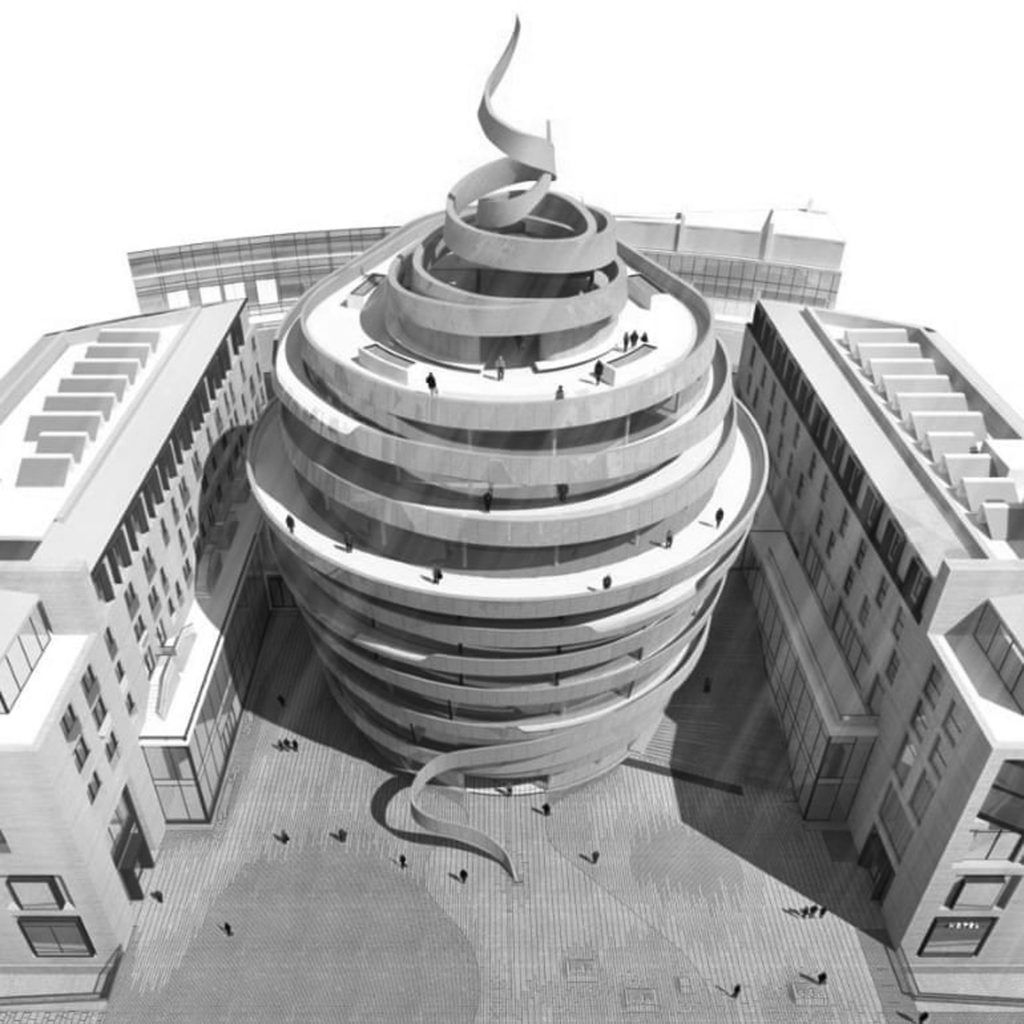
    Councillors’ preference for stupidity over corruption as an explanation of their decisions brings me, naturally enough, to Edinburgh City Council’s decision (assisted by the Scottish Government) to allow the construction of a hideous, vulgar and garish building at the centre of the St James’ development, which looks like some Arab oil-sheikh’s gilded condom after repeated usage.

    Corruption would, of course, be by far the most acceptable and least damaging explanation of the permission to build this excrescence within striking distance of the Georgian New Town, but far be it from me to allege such a thing.

    By their self-justifications shall ye know them. On the St James Quarter website we read that ‘the scheme has been designed to create an intuitive and accessible circuit around the city – anchored by places and experiences that will draw people from one place to the next… connection with great transport links within the retail circuit will aid shoppers’ mobile experience and accessibility.’ Imagine James Craig, the designer of New Town, saying this!

    Are there really people who think and talk in such language? I am afraid that there are. I met many of them in the National Health Service. They infest the police, the schools, the universities. The director of the Tate gallery, Maria Balshaw, speaks this language fluently, and perhaps owes the success of her career to her mastery of it.

    The Golden Condom is the modern equivalent of the Golden Calf. It is at the very centre of a ‘mixed-use destination of the future’ and ‘boasts a world-class retail, leisure, hotel and residential offer’. 

    Whenever any British city councillor or developer uses the word world-class, he means, of course, Dubai: that is to say, some vast and brightly lit emporium where people can buy exactly the same products as they can buy in any other such emporium, from Bogota to Banjarmasin. The world that is world-class is a vast shopping mall connected to an airport terminal. In Britain, of course, such places are frequented by the insolvent in pursuit of the unnecessary, that is when they are not consuming world-class pizzas or fair-trade cappuccinos. 

    As to the architect of the Golden Condom, what can I say? I am now suffering from outrage fatigue. I look at the architects’ latest assaults on the eyes and am struck dumb. Before them, I am as Lot’s wife post-pillarization.

  • A Line in the Sand

    A Line in the Sand

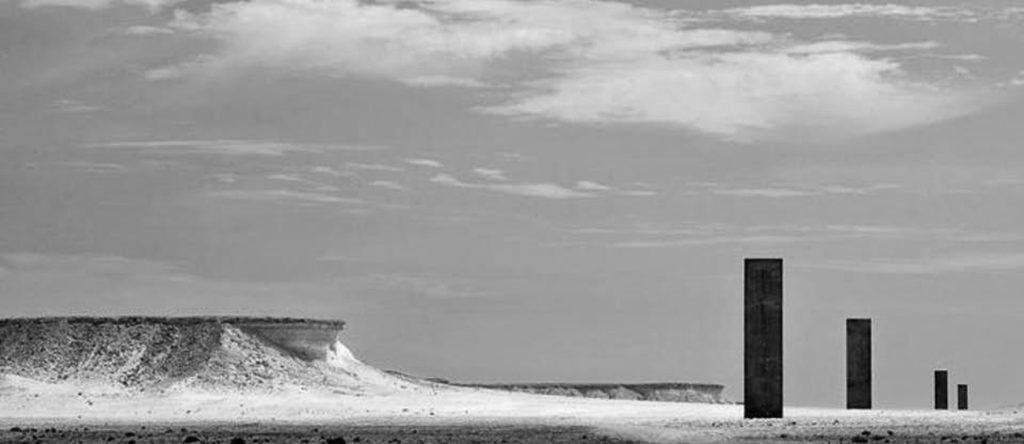
    State Art is like a virus, it knows no boundaries and spreads like wildfire. In fact, it’s worse than a virus because once it’s arrived you can’t get rid of it because there’s seemingly no cure. And there are plenty of students actually volunteering to contract it. And national boundaries are no protection for it spreads by telepathic brainwashing. This leads to many curious anomalies. Why, for example, should peoples of different cultures and traditions, all as equally rich as our own ‘western’ one, be interested in the brand names of State Art? A good example of this is currently doing the rounds. This piece (above) by Richard Serra comprises four large slabs of metal, each 45 feet high, spread over a thousand yards of a nature reserve in Qatar. A nature reserve! How could anyone in that country believe that an Arab population could possibly see and understand this as a “breathtaking national asset”. One can only conclude that the proliferation of State Art has caused a global pandemic of acute self-delusion. The reason why East/West West/East is in the news is because it’s being cleaned of graffiti. Authorities in Qatar are appalled that locals can’t understand the sculptures’ world significance. It was unveiled in 2014 and the artist hoped it would become a landmark, as if everywhere needs a landmark. Surely this is the fate of anything at all you might plonk in an expanse of desert. 

    As an addict of the sweeping non-sequitur, Serra has clearly been listening in while Gormless, occupying the next hotel room, practices in front of the mirror. He said: “I attempt to use sculptural form to make space distinct… What that piece does is give you a point of reference in relationship to a line, and your upstanding relationship to a vertical plane, and infinity, and a personal relationship to a context – and pulls that context together. It makes it graspable. That’s actually a place out there now, and there certainly wasn’t one before. We did that simply by putting up four plates.”

    Talk about stating the bleeding obvious. You could make the same claim for a line of telegraph poles.

    Overlooking the conceit of an artist prepared to inflict his lack of imagination on a nature reserve… was it Moore or Caro who said “More often than not sculpture spoils landscape”?

  • Let’s All Pretend Part 83

    David Lee

    January/February 2021

    Despite grovelling worthy of Darius on our part, The Jackdaw no longer qualifies for press view invites to the National Gallery. As a result I didn’t see the Artemisia Gentileschi show in the few weeks it was open before Boris announced the second slam dunk. It was in any case fully booked months in advance by Adlestroppers up for the Cup. What an opportunity then when the gallery announced that for eight quid you could join a curator tour on the computer. One really ought to have known better. At press views the curator’s intro, the art historical equivalent of Valium, is to be ruthlessly avoided. If ever you have the misfortune to coincide with it sprint to the exit and work backwards.

    This mercenary innovation was much disapproved of by State Art’s finest hypocrites, who queued up to blow raspberries … as if most of them hadn’t already seen the show free of charge. In a way you can hardly blame the Gallery for trying it on not least because blueberry muffins and Holbein rubbers aren’t exactly flying off the shelves.

    Having seen Artemisia’s work in galleries all over Europe, as well as in survey exhibitions, where she is the first resort for Old Mistress tokenism, I already knew much about Artemisia because the one thing she never has been is ignored. She is wrongly but conveniently promoted as a recent ‘rediscovery’ only to lend fuel to the wokey-wokey flamethrower. It’s always been obvious to anyone prepared to open their eyes that AG is a top painter. You only have to look at the first work in the exhibition, Susannah and the Elders, which she painted when she was seventeen. No man or woman now alive could match that ability so young, or indeed in most cases even in advanced age. To my mind it looks too good for any teenager to have painted. However, Letizia is adamant. And she knows a thing or two does curator Letizia, for she is our TV Virgil.

    The answer to what you get for your eight quid, apart from Letizia, is simple – not very much. I had hoped for the opportunity, which I probably won’t now experience in the flesh, to see all the pictures up close, but the film’s director had other plans and allowing intimacy with exhibits was not among them. By the end you are most familiar with Letizia’s long legs which we see walking forwards, backwards, sideways and sashaying around corners into the next gallery. Slightly on the duck-footed side is our Letizia, but still a super gel in the deportment department. And, bravo, she carries it off spiffingly in an educated tone without either notes or an autocue, and she only slips up a couple of times ­– apparently the National Gallery doesn’t stretch to re-takes.

    Our ‘tour’ is preceded by the customary self-congratulatory guff, ‘Herculean efforts’ of the staff etc. etc.. It’s their job for heaven’s sake! Mercifully, she spared us ‘taking the knee’ before kicking off. Over half the thirty minutes are Letizia wading through well-worn biographical dope on Artemisia, which is nothing more than you could read free in two minutes on Wikipedia. (Most interesting was the fact that AG was illiterate until her 20s.) The last third of our measly 30-minute allocation gave us close-ups of three pictures while Letizia repeated verbatim some of what you’d already heard during the biog – a failure in editing which anyone competent should have taped and corrected straightaway. But at least now you were close enough to these few pictures to click-stop the film and get nosey. Of course, it’s nothing like actually seeing a painting, but only a fool might think it would be.

    The film bombs for the reason television arts programmes always fail; that is, their makers think we are more interested in the Letizias of this world than in their subject. And amateurish camerawork throughout doesn’t help either. Clearly the gallery reduced production costs by finding an employee sufficiently coordinated to aim a camera straight. Or perhaps it was a young relative of the Director hoping for a leg up into the world of corporate videos. Whoever it was they have no future at Pinewood.

    If you’re going to flog a telly programme for eight quid you’d better make sure it’s good, and eight quid for this is seriously taking the mick. Any decent national gallery, understanding that the public already pay for it to exist, would have provided this mediocre online service free from the start of the exhibition. It’s the least they could do for those who can’t afford the train fare to London and the steep admission charge.